Carl Sagan Quotes
Carl Sagan Quotes
Selected quotes on cosmic perspective, scientific skepticism, exploration, and human nature from the renowned astrophysicist.
Related Notes
- Books Collection - Sagan's books included
- Observable Universe - Cosmic perspective
- Evolution - Starstuff and human origins
- Buddhism - Humility and interconnectedness
- Solutions to Fermi Paradox & Thoughts - Cosmic silence
Next Action
Connect Sagan's quotes to specific scientific concepts in other notes
The Pale Blue Dot
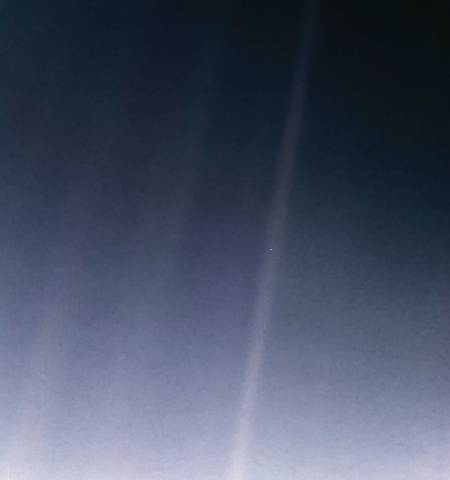
Look again at that dot. That's here. That's home. That's us. On it everyone you love, everyone you know, everyone you ever heard of, every human being who ever was, lived out their lives. The aggregate of our joy and suffering, thousands of confident religions, ideologies, and economic doctrines, every hunter and forager, every hero and coward, every creator and destroyer of civilization, every king and peasant, every young couple in love, every mother and father, hopeful child, inventor and explorer, every teacher of morals, every corrupt politician, every 'superstar,' every 'supreme leader,' every saint and sinner in the history of our species lived there-on a mote of dust suspended in a sunbeam. The Earth is a very small stage in a vast cosmic arena. Think of the endless cruelties visited by the inhabitants of one corner of this pixel on the scarcely distinguishable inhabitants of some other corner, how frequent their misunderstandings, how eager they are to kill one another, how fervent their hatreds. Think of the rivers of blood spilled by all those generals and emperors so that, in glory and triumph, they could become the momentary masters of a fraction of a dot. Our posturings, our imagined self-importance, the delusion that we have some privileged position in the Universe, are challenged by this point of pale light. Our planet is a lonely speck in the great enveloping cosmic dark. In our obscurity, in all this vastness, there is no hint that help will come from elsewhere to save us from ourselves. The Earth is the only world known so far to harbor life. There is nowhere else, at least in the near future, to which our species could migrate. Visit, yes. Settle, not yet. Like it or not, for the moment the Earth is where we make our stand. It has been said that astronomy is a humbling and character-building experience. There is perhaps no better demonstration of the folly of human conceits than this distant image of our tiny world. To me, it underscores our responsibility to deal more kindly with one another, and to preserve and cherish the pale blue dot, the only home we've ever known.
- "It has been said that astronomy is a humbling and character-building experience. There is perhaps no better demonstration of the folly of human conceits than this distant image of our tiny world. To me, it underscores our responsibility to deal more kindly with one another and to preserve and cherish the pale blue dot, the only home we've ever known."
Cosmic Perspective and Starstuff
-
"If you want to make an apple pie from scratch, you must first create the universe."
-
"The nitrogen in our DNA, the calcium in our teeth, the iron in our blood, the carbon in our apple pies were made in the interiors of collapsing stars. We are made of starstuff."
-
"The cosmos is within us. We are made of star-stuff. We are a way for the universe to know itself."
-
"Every one of us is, in the cosmic perspective, precious. If a human disagrees with you, let him live. In a hundred billion galaxies, you will not find another."
-
"Who are we? We find that we live on an insignificant planet of a humdrum star lost in a galaxy tucked away in some forgotten corner of a universe in which there are far more galaxies than people."
-
"Well, some hoped, even if the Earth isn’t at the center of the universe, our sun is. The sun is our sun, so the Earth is approximately at the center of the universe. Perhaps some of our pride could in this way be salvaged. But by the nineteenth century, observational astronomy had made it clear that the sun is but one lonely star in a great self gravitating assemblage of suns, called the Milky Way Galaxy."
-
"The long standing view as summarized by the philosopher Emmanuel Kant that ‘without man, the whole of creation would be a mere wilderness, a thing in vein, and have no final end’ is revealed to be self-indulgent folly. A principle of mediocrity that seems to apply to all our circumstances. We would not have known beforehand, that the evidence would be so repeatedly and thoroughly incompatible with the proposition that human beings are at the center stage in the universe. But most of the debates have now been settled decisively in favor of a position that, no matter how painful, can be encapsulated in a single sentence: ‘we have not been given the lead in the cosmic drama’, perhaps someone else has, perhaps no one else has. In either case, we have good reason for humility."
Exploration and Imagination
-
"Somewhere, something incredible is waiting to be known."
-
"Imagination will often carry us to worlds that never were, but without it we go nowhere."
-
"Books are like seeds. They can lie dormant for centuries and then flower in the most unpromising soil."
-
"Exploration is in our nature. We began as wanderers, and we are wanderers still. We have lingered long enough on the shores of the cosmic ocean. We are ready at last to set sail for the stars."
-
"The surface of the Earth is the shore of the cosmic ocean. Recently, we’ve waded a little way out – maybe ankle-deep – and the water seems inviting."
-
"Our loyalties are to the species and the planet. We speak for Earth. Our obligation to survive is owed not just to ourselves but also to that Cosmos, ancient and vast, from which we spring."
The Scientific Method and Skepticism
-
"Absence of evidence is not evidence of absence."
-
"For me, it is far better to grasp the Universe as it really is than to persist in delusion, however satisfying and reassuring."
-
"There are no forbidden questions in science, no matters too sensitive or delicate to be probed, no sacred truths."
-
"Better the hard truth, I say, than the comforting fantasy. If it can be destroyed by the truth, it deserves to be destroyed by the truth."
-
"If ‘fulfilled prophecy’ is your criterion, why do you not believe in materialistic science, which has an unparalleled record of fulfilled prophecy? Consider, for example, eclipses."
-
"Science is based on experiment, on a willingness to challenge old dogma, on an openness to see the universe as it really is. Accordingly, science sometimes requires courage - at the very least the courage to question the conventional wisdom."
-
"Science is an attempt, largely successful, to understand the world, to get a grip on things, to get hold of ourselves, to steer a safe course. Microbiology and meteorology now explain what only a few centuries ago was considered sufficient cause to burn women to death."
-
"One of the reasons for its success is that science has a built-in, error-correcting machinery at its very heart. Some may consider this an overbroad characterization, but to me every time we exercise self-criticism, every time we test our ideas against the outside world, we are doing science. When we are self-indulgent and uncritical, when we confuse hopes and facts, we slide into pseudoscience and superstition."
-
"In science it often happens that scientists say, 'You know that's a really good argument; my position is mistaken,' and then they would actually change their minds and you never hear that old view from them again. They really do it. It doesn't happen as often as it should, because scientists are human and change is sometimes painful. But it happens every day. I cannot recall the last time something like that happened in politics or religion."
The Burden of Skepticism
"It seems to me what is called for is an exquisite balance between two conflicting needs: the most skeptical scrutiny of all hypotheses that are served up to us and at the same time a great openness to new ideas... If you are only skeptical, then no new ideas make it through to you... On the other hand, if you are open to the point of gullibility and have not an ounce of skeptical sense in you, then you cannot distinguish the useful ideas from the worthless ones.”
— “The Burden of Skepticism,” The Skeptical Inquirer, 1987
-
"If you are only skeptical, then no new ideas make it through to you. You never learn anything new. You become a crotchety old person convinced that nonsense is ruling the world. (There is, of course, much data to support you.) But every now and then, maybe once in a hundred cases, a new idea turns out to be on the mark, valid and wonderful. If you are too much in the habit of being skeptical about everything, you are going to miss or resent it, and either way you will be standing in the way of understanding and progress. On the other hand, if you are open to the point of gullibility and have not an ounce of skeptical sense in you, then you cannot distinguish the useful as from the worthless ones."
-
"Now, what's the difference between an invisible, incorporeal, floating dragon who spits heatless fire and no dragon at all? If there's no way to disprove my contention, no conceivable experiment that would count against it, what does it mean to say that my dragon exists? Your inability to invalidate my hypothesis is not at all the same thing as proving it true. Claims that cannot be tested, assertions immune to disproof are veridically worthless, whatever value they may have in inspiring us or in exciting our sense of wonder. What I'm asking you to do comes down to believing, in the absence of evidence, on my say-so."
-
"One of the saddest lessons of history is this: If we’ve been bamboozled long enough, we tend to reject any evidence of the bamboozle. We’re no longer interested in finding out the truth. The bamboozle has captured us. It’s simply too painful to acknowledge, even to ourselves, that we’ve been taken. Once you give a charlatan power over you, you almost never get it back."
Compassion in Skepticism
-
"People are not stupid. They believe things for reasons. The last way for skeptics to get the attention of bright, curious, intelligent people is to belittle or condescend or to show arrogance toward their beliefs."
-
"You can get into a habit of thought in which you enjoy making fun of all those other people who don't see things as clearly as you do. We have to guard carefully against it."
-
"In the way that skepticism is sometimes applied to issues of public concern, there is a tendency to belittle, to condescend, to ignore the fact that, deluded or not, supporters of superstition and pseudoscience are human beings with real feelings, who, like the sceptics, are trying to figure out how the world works and what our role in it might be. Their motives are in many cases consonant with science. If their culture has not given them all the tools they need to pursue this great quest, let us temper our criticism with kindness. None of us comes fully equipped."
From The Demon-Haunted World
“The chief deficiency I see in the skeptical movement is its polarization: Us vs. Them — the sense that we have a monopoly on the truth; that those other people who believe in all these stupid doctrines are morons; that if you're sensible, you'll listen to us; and if not, to hell with you. This is nonconstructive. It does not get our message across. It condemns us to permanent minority status.”
— The Demon-Haunted World: Science as a Candle in the Dark
Science, Religion, and Spirituality
-
"Science is not only compatible with spirituality; it is a profound source of spirituality."
-
"Skeptical scrutiny is the means, in both science and religion, by which deep insights can be winnowed from deep nonsense."
-
"If we long to believe that the stars rise and set for us, that we are the reason there is a Universe, does science do us a disservice in deflating our conceits?"
-
"Who is more humble? The scientist who looks at the universe with an open mind and accepts whatever the universe has to teach us, or somebody who says everything in this book must be considered the literal truth and never mind the fallibility of all the human beings involved?"
-
"We can judge our progress by the courage of our questions and the depth of our answers, our willingness to embrace what is true rather than what feels good."
-
"The fact is that far more crime and child abuse has been committed by zealots in the name of God, Jesus and Mohammed than has ever been committed in the name of Satan. Many people don’t like that statement, but few can argue with it."
-
"How is it that hardly any major religion has looked at science and concluded, “This is better than we thought! The Universe is much bigger than our prophets said, grander, more subtle, more elegant?” Instead they say, “No, no, no! My god is a little god, and I want him to stay that way.” A religion, old or new, that stressed the magnificence of the Universe as revealed by modern science might be able to draw forth reserves of reverence and awe hardly tapped by the conventional faiths."
-
"The major religions on the Earth contradict each other left and right. You can’t all be correct. And what if all of you are wrong? It’s a possibility, you know. You must care about the truth, right? Well, the way to winnow through all the differing contentions is to be skeptical. I’m not any more skeptical about your religious beliefs than I am about every new scientific idea I hear about. But in my line of work, they’re called hypotheses, not inspiration and not revelation."
-
"You see, the religious people—most of them—really think this planet is an experiment. That's what their beliefs come down to. Some god or other is always fixing and poking, messing around with tradesmen's wives, giving tablets on mountains, commanding you to mutilate your children, telling people what words they can say and what words they can't say, making people feel guilty about enjoying themselves, and like that. Why can't the gods leave well enough alone? All this intervention speaks of incompetence. If God didn't want Lot's wife to look back, why didn't he make her obedient, so she'd do what her husband told her? Or if he hadn't made Lot such a shithead, maybe she would've listened to him more. If God is omnipotent and omniscient, why didn't he start the universe out in the first place so it would come out the way he wants? Why's he constantly repairing and complaining? No, there's one thing the Bible makes clear: The biblical God is a sloppy manufacturer. He's not good at design, he's not good at execution. He'd be out of business if there was any competition. Why couldn't he have given us the glorious result, without the long and tedious prologue?"
Education and Children
-
"Knowing a great deal is not the same as being smart; intelligence is not information alone but also judgement, the manner in which information is coordinated and used."
-
"Frederick Douglass taught that literacy is the path from slavery to freedom. There are many kinds of slavery and many kinds of freedom, but reading is still the path."
From The Demon-Haunted World
“I find many adults are put off when young children pose scientific questions. Why is the Moon round? the children ask. Why is grass green? What is a dream? How deep can you dig a hole? When is the world’s birthday? Why do we have toes? Too many teachers and parents answer with irritation or ridicule, or quickly move on to something else: ‘What did you expect the Moon to be, square?’ Children soon recognize that somehow this kind of question annoys the grown-ups. A few more experiences like it, and another child has been lost to science. Why adults should pretend to omniscience before 6-year-olds, I can’t for the life of me understand. What’s wrong with admitting that we don’t know something? Is our self-esteem so fragile?”
— The Demon-Haunted World: Science as a Candle in the Dark
“I don't think science is hard to teach because humans aren't ready for it, or because it arose only through a fluke, or because, by and large, we don't have the brainpower to grapple with it. Instead, the enormous zest for science that I see in first-graders and the lesson from the remnant hunter-gatherers both speak eloquently: A proclivity for science is embedded deeply within us, in all times, places, and cultures. It has been the means for our survival. It is our birthright. When, through indifference, inattention, incompetence, or fear of skepticism, we discourage children from science, we are disenfranchising them, taking from them the tools needed to manage their future.”
— The Demon-Haunted World: Science as a Candle in the Dark
Politics, Power, and Society
-
"Widespread intellectual and moral docility may be convenient for leaders in the short term, but it is suicidal for nations in the long term. One of the criteria for national leadership should therefore be a talent for understanding, encouraging, and making constructive use of vigorous criticism."
-
"This planet is run by crazy people. Remember what they have to do to get where they are. Their perspective is so narrow, so...brief. A few years. In the best of them a few decades. They care only about the time they are in power."
-
"The best way to avoid abuses is for the populace in general to be scientifically literate, to understand the implications of such investigations. In exchange for freedom of inquiry, scientists are obliged to explain their work. If science is considered a closed priesthood, too difficult and arcane for the average person to understand, the dangers of abuse are greater. But if science is a topic of general interest and concern - if both its delights and its social consequences are discussed regularly and competently in the schools, the press, and at the dinner table - we have greatly improved our prospects for learning how the world really is and for improving both it and us."
From The Demon-Haunted World
“If we can't think for ourselves, if we're unwilling to question authority, then we're just putty in the hands of those in power. But if the citizens are educated and form their own opinions, then those in power work for us. In every country, we should be teaching our children the scientific method and the reasons for a Bill of Rights. With it comes a certain decency, humility and community spirit."
— The Demon-Haunted World: Science as a Candle in the Dark